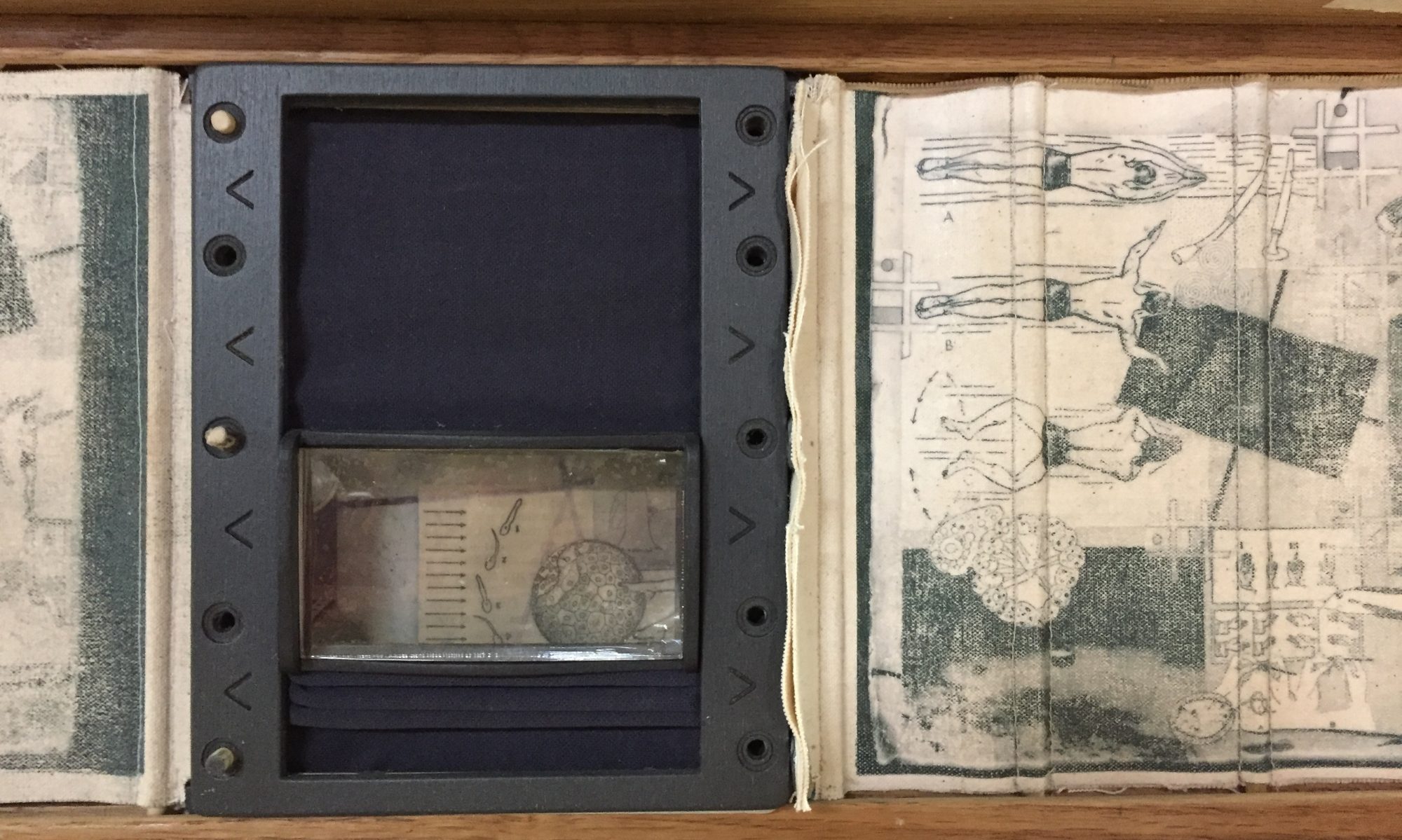


The full droit de suite-implemented auction/resale project includes the following separate elements:
- scopingRack: Materials: Archival honeycomb board, cherry wood, paper, UV-protected matte medium, acrylic. Dimensions: 30.5”L x 5”W x 37”H
- scopeTokens:(multiple): Materials: Paper prints, resin, copper tubing. Dimensions: 1.625”Diameter
- tokenBoxes:Materials: Wood, paper, flocking, acrylic, shellac, varnish. Dimensions: Various
- challengeTableaux(14): Materials: MDF, inkjet print paper, acrylics, UV-protected matte medium. Dimensions: (Each) 18”L x 4”W x .25”
- tableauxHolds: Materials: Wood, shellac. Dimensions: 9.25”L x 3.25”W x 4.5”H
A core concept behind this piece is an imagined “scientific game” of search and re-search where players vie to locate specified biological organisms amidst a swarming sea of microscopic collage imagery. For more exacting investigations, an X/Y positional magnifying lens (scopingUnit) aids in the discovery of extraordinarily small biological details within.
“Yes, indeedy folks, step right up, ..guaranteed edutainment and *fun for the whole family!”
Ahh-hh, ..however, it’s not really simply about the enjoyably ludic passing of time. A significant motivation behind making this collection was my inaugural attempt at a gamified realization of artist resale royalties from secondary market transactions generated between auctions, galleries, museums, and collector-to-collector.
Hence, the entire “game system” comprises myriad elements that, in toto, as a work of art designed to have provenance-tracking administered through a droit de suite system (DDSS); the launch of the project being instigated via an inaugural art auction interchange. Tracking of subsequent exchange transactions between sellers and collectors remains bounded by the contract terms of the original DDSS; replete with blockchain-monitored and authenticated bidding data available for transparent review. Through its evergreen ledger, the trading system eases the politics and privacy securities of traditional art auction house transaction rules (personal, public, or corporate), by dynamically actuating vital game-balancing of negotiations among buyers/sellers/traders/advisors. All game elements are serially registered via their perpetual exchange records of buys/sells for the collectors’ ongoing review, as they compete to fulfill acquisition of the entire game set.
Once a single collector has managed to acquire the full constituent set of game elements, playing is actually fairly straightforward: 1) A player begins by recording their starting time. They then: 2) Select a challengeTableau from those available within their tableauxHold box; 3) Slide it down into the scopingRack’ top-located activeSlot; 4) In lower-to-upper progression and advancing from the left side of the windowed cells, study the token images presented ; 5) Guide the 2DOF scopingUnit across the centralDisplaySurface while viewing through the lens and/or studying the (optional) simulcast video monitor ; 6) Focus on magnified imagery to match what is exhibited on the chosen challengeTableau, 7) Upon successful image location, stop timer and record duration; 8) Locate the find’s corresponding physical scopeToken; 9) Drop the awarded token down into its associated holding cell slot, 10) Alternate between other players, and repeat as determined by mutual agreement to determine winner.
* Based on my definition of “fun”.