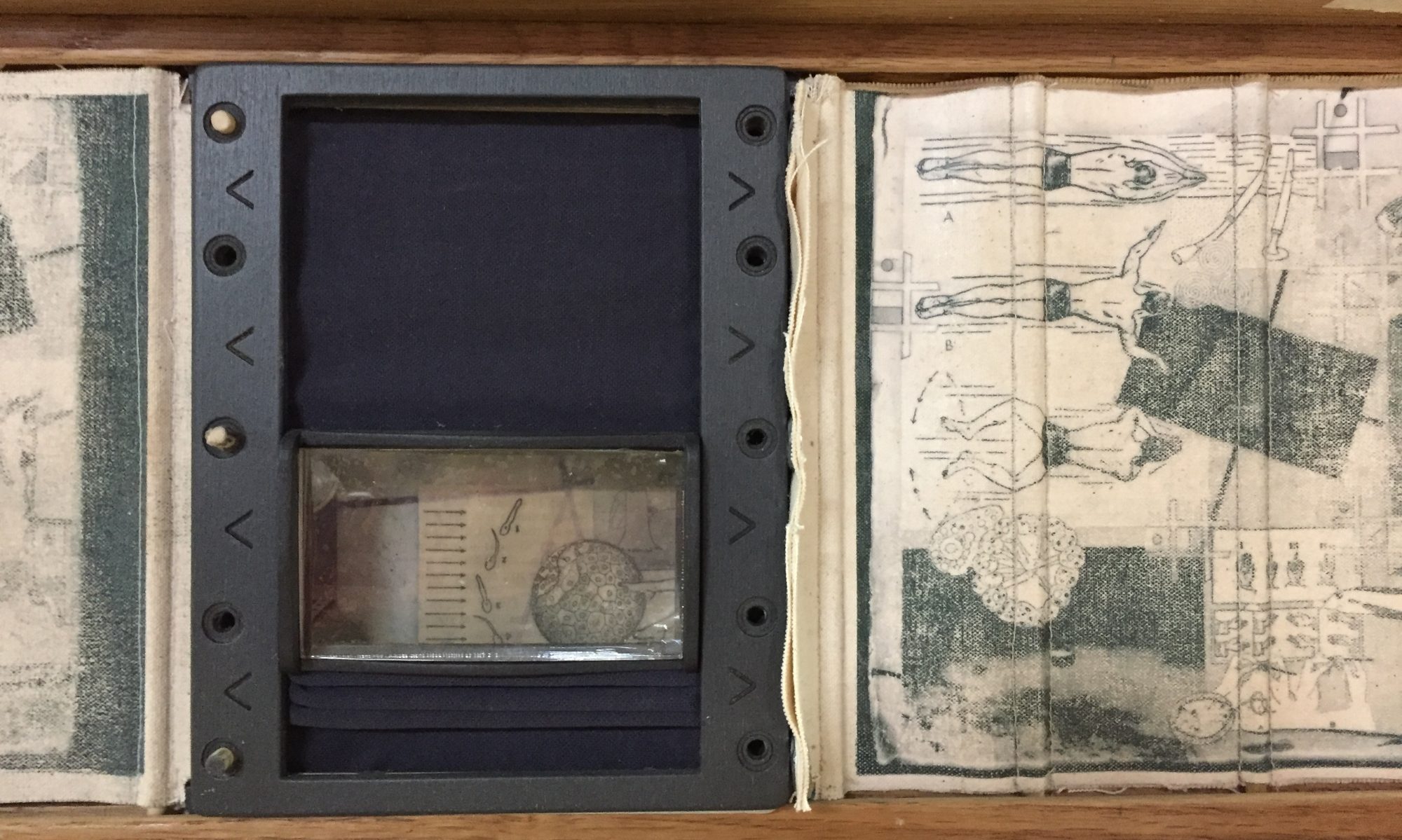
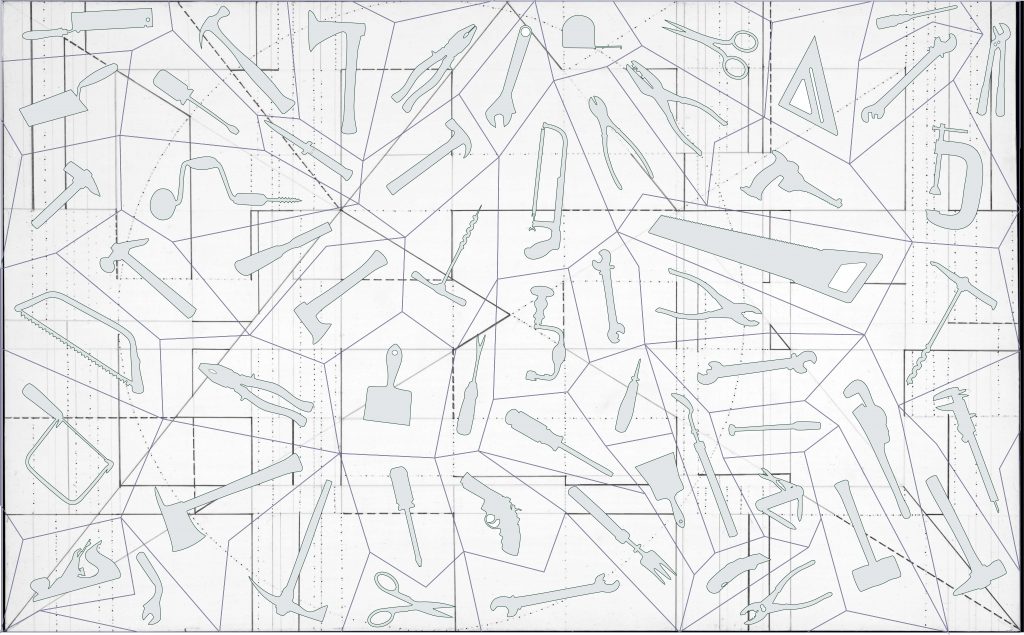
handTools
[2016-18]
Materials: Wood, paper, UV-protected matte medium, acrylic, plexiglas.
Gestalt Display Case: 32.5”L x 21.25”W x 1.75”H
Individual Component Units: 9.75”L x 3.5”W x 2.25”H
Conceptually, what is intended to draw Collectors toward handTools is that the piece doesn’t just sit there as an object—it invites participation, strategy, and a bit of obsession.
Produced as multiple gestalt sets, these puzzle-like groupings riff on hand-tool iconography, but they’re also very intentionally built as small-scale testbeds: playable, tactile models that stand in for their eventual 10× full-scale counterparts. Each component is auctioned individually, which immediately changes the relationship between “owning” and “completing.”
The project is instigated through a framework of game rules and the emergent dynamics of a droit de suite–guided art auction. From your Collector’s side, that means you’re not simply buying a piece—you’re navigating a system. You’re watching what others value, anticipating moves, weighing whether to secure a specific element or hold out for a subset that brings you closer to the work’s intended end state: an aggregated, gestalt whole.
Especially compelling is how handTools braids together game theory and psychology—how perception becomes “value,” and how consensus realities form in real time—alongside media and the very consumer-facing economic strategies that typically sit in the background of art ownership. Here, those strategies are the content.
The play-testing phase opens up some clear questions worth paying attention to:
- Perceived value: what we reward, what we chase, and how familiar incentives in art commerce get abstracted and reattached.
- Gamesmanship and posturing: how play maps onto real-world socio-economic signaling—and how emotional feedback loops shape decision-making.
- Scalability: what these smaller sets reveal that can inform the final, full-scale rendition.
- Engagement with droit de suite: how collectors and buyers understand (or resist) the principle, and what it looks like in practice.