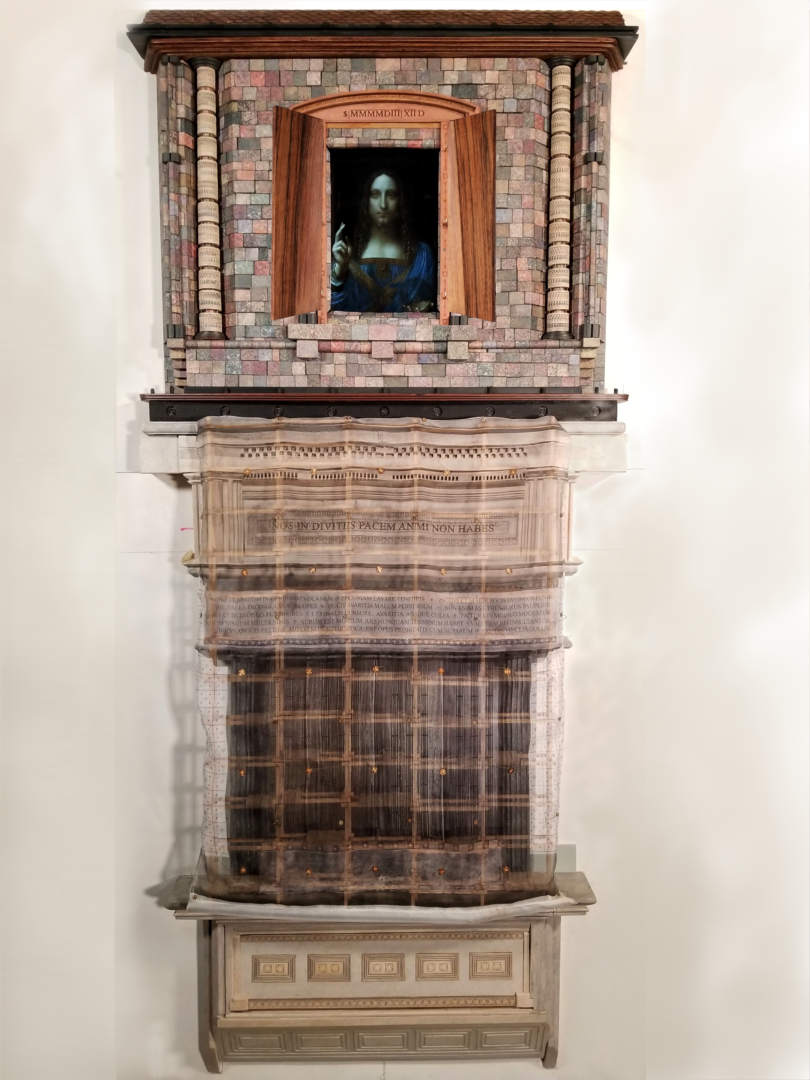
sMundi [2018-2021]
Materials: Wood, inkjet prints, acrylics, micro-controller, sensors, digital tablet]
Dimensions: ~68.5” x 30” x 5.5”
In 2017, Christie’s sold Salvator Mundi for an astonishing $450,312,500—the highest price ever paid for a painting at auction. The gavel fell, the bidder stayed anonymous, and a small walnut-panel portrait of Christ was instantly recast as a global-status trophy.
But what, exactly, was purchased that night?
The work’s attribution to Leonardo da Vinci remains contested, its restoration history fuels skepticism, and its post-sale aura—private, opaque, power-adjacent—only intensifies the unease. sMundi emerges from that collision of reverence and spectacle: a faux-tabernacle built to provoke contemplation, and to question the increasingly warped logic of the art market.
The second decade of the 21st century handed the art world a spectacle it can’t seem to quit: Christie’s sale of Salvator Mundi—and the highest price ever paid for a painting at auction. When the auctioneer’s gavel finally dropped, an anonymous bidder had pledged an almost cartoonish $450,312,500. It’s the kind of figure that can eclipse the GDP of some small countries.
All that money. For what—reverence, beauty, history? Or something else entirely?
The painting—an image of Christ as “Savior of the World”—has been attributed to Leonardo da Vinci, but the attribution has never been a settled fact. A chorus of critics and scholars point to passages of paint handling and compositional decisions that feel inconsistent with Leonardo’s verified works, and some argue the piece is closer to apprentice-grade: a studio effort, or a later copy, elevated by branding more than by brushwork. Complicating matters further is the work’s restoration history—especially the most recent, boldly extensive intervention by conservator Dianne Dwyer Modestini, whose reconstruction and surface refinement have fueled questions about where “original” ends and modern recovery begins.
And then there’s the owner—or rather, the carefully maintained fog around ownership.
Because this isn’t merely an art purchase; it’s a transaction that reads like geopolitics in a gilded frame. A sacred Christian image, converted into an ultra-private asset, absorbed into the orbit of immense, unaccountable wealth—wealth so vast it can buy not just objects, but silence, distance, and narrative control.
That tension matters. Salvator Mundi trades on religious iconography—on the visual authority of Christ—yet its modern afterlife unfolds in a world where faith is often weaponized, where religious identity collides with state power, and where sectarian histories make “ownership” feel less like stewardship and more like conquest-by-collection. In that context, the painting’s disappearance behind closed doors doesn’t read as tasteful discretion; it reads as the kind of possession that borders on the nefarious: not illegal, perhaps, but unmistakably antithetical to the very moral messaging the image purports to embody.
So even if you set aside the authorship debate and the questions of artistic quality, what remains is a small, delicately painted walnut panel that has been inflated into an opulent totem—an emblem of conspicuous consumption, status theater, and a market logic that rewards spectacle over substance.
In many ways, the Salvator Mundi saga becomes a parable for our moment: how fine art is promoted, auctioned, and warehoused; how cultural meaning is monetized; and how the art world’s glamour can launder the optics of extreme inequality.
That’s why I’m drawn to sMundi: a faux-tabernacle meant to provoke deeper contemplation and sharpen conceptual commentary—toward how peculiarly ludicrous, irrational, and increasingly warped the art market can be, especially when a “holy” image becomes just another trophy in the hands of wealth that has slipped its leash.